


On January 3, I published The Quiet Power of Changing Your Environment. The same day, I moved to Helsinki for an exchange semester. I actually wrote that post on the way there at the airport and on the plane.
In it, I called the move a deliberate system reset and made six claims about what a new environment does to you. A lot of you asked me to report back. So here it is: the honest scorecard.
But first, something I didn’t say in January. I was hoping a semester abroad would kind of let me reinvent myself and start from scratch.
Objectively, I’m in a privileged situation, and on paper everything was going really well, and I have amazing friends and family around. Still, I had this sense of lacking purpose, and a quiet anxiety of being alone with my thoughts. Helsinki felt like a chance to be pulled into a new world and a new daily life.
I’ve now been back home for about five months, and I think that makes this the honest time to write it. Anyone can feel transformed while they’re still somewhere new. The real test of a reset is what’s still there after you come home.
So let’s go through the claims I made, one by one.
1. Environment beats willpower
Verdict: True. It just didn’t vote the way I expected.
I saw the move as a chance to solidify some habits, build new ones, and find out which ones I even wanted. The best example is the sauna.
I’m a big sauna fan and had wanted to make it part of my weekly routine for a long time. At home, sauna was something I did when I had the time and the access. In Finland, it’s simply part of life.
It’s everywhere: in apartment buildings, in gyms, in public saunas right by the sea. Within a few weeks, I was averaging four to five sessions a week. I never had to push for it. It happened almost automatically, because the environment made it the default.

But the environment didn’t only vote for the habits I had planned. Here’s one random week in March, straight from my calendar:
Monday: gym, a murder mystery evening, then karaoke
Tuesday: Finnish study, lunch together, an Irish pub for St. Patrick’s Day
Wednesday: gym, a bit of studying, a bit of work, planning a trip together
Thursday: public sauna and ice bathing, then playing piano and singing together in the evening
Friday: gym, dinner at a friend’s place, the pub, karaoke. Again. And watching the Northern Lights at night.
This wasn’t a special week. It was a normal one.
The environment did beat my willpower. It just voted for people over output. That’s also the honest reason this newsletter went quieter: I wanted to be in the moment as much as I possibly could.
The lesson: a new environment doesn’t just remove your old defaults. It installs new ones too. You can pick some of them, but you can’t predict all of them in advance.
2. Identity resets when nobody knows you
Verdict: True. But I didn’t become someone new.
In Helsinki, nobody had a version of me on file. Out of all the people I got to know, I wasn’t “the guy who’s always working on something” to a single one of them. No history to live up to, and none to live down to.
What came out wasn’t a new person. It was parts of me I’d been quietly editing out.
At home, I sometimes overthink how I come across. Honestly, I still do. I’m a bit of a people pleaser, and sometimes I catch myself agreeing with people just because I’m scared to offend them.
In Helsinki, there were no expectations, so I could start from zero and simply be myself. When you’re just getting to know someone, you figure out each other’s interests and values in real time. Even disagreement isn’t bad. It’s how you learn from each other.
I also realized how much I love doing stupid stuff just to make people laugh. I can be a very serious guy, but deep down I’m a pretty silly one too. At home, I sometimes hold that side back.
In Finland, I had neither the time nor a reason to. Being the guy doing silly things to make people laugh, the one telling people out loud that I appreciated them, the one everybody wanted a karaoke duet with. That last one still surprises me. People told me a lot of things about myself that I’d never realized were true.

The lesson: a reset isn’t about inventing a new identity. It’s about getting a break from your old labels long enough to see what’s underneath them.
3. Friction resets make habits negotiable
Verdict: True. And it showed me which of my habits were real.
When you move, every routine you have is up for renegotiation: where you train, when you study, what a normal evening looks like.
I had also scaled my job down for the semester, so I suddenly had time to decide what I wanted my days to look like. Learning, training, eating well, socializing. Building those habits was easy, and so was sticking to them.
Some habits survived the move without a fight:
Japanese. In April, still in Helsinki, I hit one full year of daily Japanese study. On May 24, I hit a full year of daily Anki practice.
The gym. Consistency has never been my problem, but for most of my life I’ve trained in a small home gym in the back of our house. In Helsinki, I had a decent university gym with better machines, a nice atmosphere, and I was already on campus anyway. I also found people to train with, which made it so much more fun.
Work and university. I kept my job running next to my courses, part-time for the first time since I started working full-time. Since coming back, I’m full-time again.
Other habits died quietly. This newsletter was the obvious one.
What’s the difference? The habits that survived didn’t depend on a place/setting. My Japanese study lives on my phone and laptop. Gyms exist in every city.
My writing technically didn’t need a place either, but it needed a slot in my calendar. And that slot suddenly belonged to other things and other people.
The lesson: if a habit only survives in one specific setting, it isn’t a habit yet. It’s a routine. Moving is a really fast way to find out which is which.
4. Novelty accelerates learning
Verdict: True. It also bends time.
March alone felt like a year.
A spontaneous solo trip to Lapland. Temporary goodbyes to friends who, by then, already felt like family. Friends visiting from home. Sitsit, the Finnish student dinner parties with way too much singing (I loved the singing). A spontaneous trip to Warsaw, where I somehow ended up taking shots with a Ukrainian uncle in a Georgian restaurant. In Poland. During my exchange in Finland.
Hell of a side quest.
All of that on top of the daily rhythm: studying, lunches and dinners together, parties, sauna, gym, Japanese.
At home, a month of routine often compresses into a blur and goes by like nothing. In Helsinki, almost every week had at least one first. That’s why five months feel like two years in my memory.

And the learning followed the novelty. Being in a new environment, and redefining myself alongside it, taught me things I wouldn’t have learned otherwise.
Even studying itself got easier, because I could give learning its own room, one with no history attached. Whenever I sat down there, say in the university library, “learning Tobi” simply switched on.
The novelty does wear off after a while. But that isn’t a bad thing. It means you’ve stopped visiting and started living there.
That phase can feel hard at first. But it’s where you build routines in a new place, really start to appreciate it, and where you actually grow.
The lesson: if your days all look the same, your memories will too. Novelty isn’t just fun. It’s how you get more life out of the same amount of time.
5. Chosen discomfort multiplies growth
Verdict: True. But mostly because my fear was wrong.
Take Lapland. The trip itself ended up among the coolest experiences of my life. But before it, and on the bus up there, I had a bad feeling.
For the first time in a while, I felt lonely. I was about to spend a week alone, and I was scared I’d miss out on everything happening in Helsinki with my new amazing friends. (Spoiler: I wasn’t alone. I met people there too.)
Some of that fear was honestly silly. Part of me worried they’d move on without me and forget about me. I know how that sounds, but sometimes your mind just goes there.
In the end, fears like that turned out to be useless, no matter which fear it was. What I experienced again and again: if you go in with the right energy and the right mindset, it works out.
If you’ve read What Roller Coasters Teach You About Life, you know the idea: the anticipation is almost always worse than the ride.
Here’s the twist. The discomfort I was afraid of, being alone, never really showed up once the trip started. Just like on a roller coaster: once you’re over the first hill, you realize the fear was for nothing.
6. The hidden benefit: optionality
Verdict: True. But it comes with questions you can’t unask.
On my last night in Helsinki, saying goodbye took me over half an hour. Not because I was drunk (okay, a little). Because every goodbye turned into a hug, and every hug turned into a little conversation.
People cried. I cried.
Five months earlier, I had been scared I might spend the whole semester lonely. It turned out to be the complete opposite. You’d never think a place that gets as cold as -28 °C could hold so much warmth, all thanks to the people I met along the way.
I flew home on May 30. In the days after, I was really sad about leaving that whole life behind. Back home, basically nobody knows what it was like. I can tell people about it, but nobody will truly understand, because they weren’t there. This was hard for me to realize at first.
That’s not on them at all, though. Some of them even came all the way to Helsinki to visit, and they’re a big part of why coming home still felt like coming home.
That’s a normal part of life, but it’s still hard to make sense of. At one point I wanted to cry, thinking back to the semester. But I couldn’t, and I was upset that I couldn’t. Strange, isn’t it?

Here’s the optionality part. I now know, not just hope, that I can show up in a city where I know nobody and build a life from zero in a few months. That’s freeing.
It’s also a little uncomfortable. It means staying anywhere is no longer a default. It’s a choice I have to keep making consciously.
The lesson: a reset gives you great options. It also gives you questions you can’t unask.
So what didn’t change?
If I’m honest, part of me hoped a new city would tell me what to do with my life. I know how silly that sounds. It didn’t.
The big question I left with came back with me in my luggage. Am I spending my time on the right things? What do I go all in on? What do I let go of?
Same ambition. Same restlessness. Same guy who wants to do ten things at once, just with a lot more proof that he can handle change.
Here’s how I’d put it now: a new environment changes what you do. It doesn’t tell you what you want. You still have to figure that part out yourself, and no city can do it for you.
If you want to try it
You don’t need a semester abroad. A solo trip like my Japan solo adventure, a month somewhere new, or even a gym where nobody knows you: it works at smaller scales too.
If you do go, here’s what I’d do:
Give it an end date. Knowing it would end is the reason I said yes to everything. There’s a strange beauty in things that don’t last.
Decide which habits you want before you leave.
Make the important ones portable.
Let the rest go on purpose, not by accident.
Say yes, especially early. The people you meet in the first weeks become your people.
Watch what the new place rewards. It will reward something. Make sure you’re okay with what that is.
Bottom line
In January, I ended with this: often, we don’t need more discipline. We just need a new environment.
I still believe that. I’d just add one thing.
I moved to Helsinki to reset my habits. What it actually reset was my fear of starting over.
I went in with some worry. Who knows, maybe I’d end up alone. The plain fear of the unknown. I came out knowing I can start from zero, and that I don’t need to become someone else to do it.
You can’t learn that from a book. You have to change the room.
And no matter where you go, the most important part will always be the people.
To everyone I met in Helsinki: thank you for turning a city where I knew nobody into a second home. And to everyone back home: thank you for still being there when I got back and for being the one thing I’d never want to reset about my environment.
Moi moi, Suomi. Kiitos for everything.
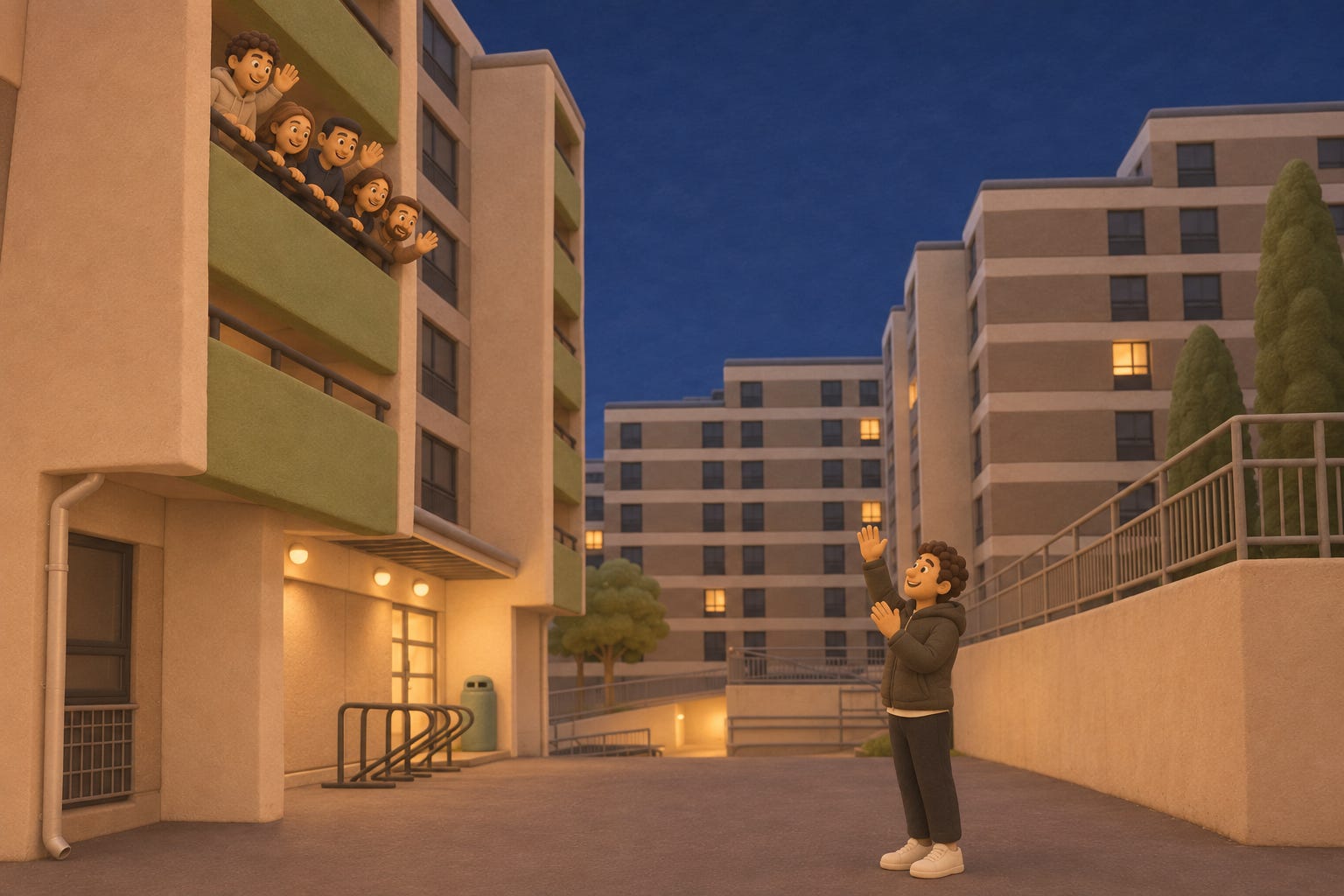
my exact last moment in Helsinki
See you next Saturday,
Tobi
When have you changed your environment? A move, a semester abroad, a long trip? What changed, and what came home with you? Tell me in the comments.