


In spring 2025, I decided to learn Japanese. I had zero prior knowledge, and the decision came out of nowhere, from one day to the next. That’s just how I work: when something really grabs me, I go all in.
I fell in love with how the language works almost immediately. I’m a big fan of Japan and Japanese culture, and I had a concrete reason to start: my first solo trip there. My thinking was simple. If I got lonely and didn’t meet anyone, at least I could sit in an izakaya and chat with the people around me.
About 1.5 years later, I know over 10,000 words. That’s roughly 18 new words per day, every day. Here’s how I did it, and why the method works for far more than languages.
Why it’s worth it (and what it costs)
I’m writing this right after coming back from my second trip to Japan. Knowing the language made it so much more memorable. It led to amazing conversations and memories that simply wouldn’t have happened otherwise.
It really feels like unlocking a new skill, one that opens up a whole range of experiences you can’t reach without it. If learning a language has been on your mind, I highly recommend it.
But be honest with yourself first: you need to really freaking want it. Even with the most efficient approach, it takes a lot of time and persistence. That’s especially true for a language as different from Western languages as Japanese. Still, for me it’s been 100% worth it.
The secret isn’t magic
There is a secret, but it’s no magic trick. It’s active recall combined with spaced repetition, and it only works if you show up every day.
Active recall means pulling an answer out of your own memory instead of rereading it. Spaced repetition means reviewing it again just before you’d forget it. I went deeper into both in my post on learning techniques. Here, all you need to know is that I applied them every single day.
Why focus on words? When you start a new language, vocabulary is the single biggest lever you can pull, and it stays that way for a long time. Today, immersion matters more for me than raw word count. But for a very long stretch at the start, vocabulary is what moves the needle most.
How I used Anki
The tool I used is Anki, a flashcard app built around exactly these two principles. It’s simple because it gives you only what you need. There are lots of settings you can tweak, but you don’t need them to get started. YouTube is full of in-depth setup guides if you want to go further.
This isn’t only for languages, by the way. It works in any field where you need to memorize information. I used Anki throughout my computer science studies and averaged 29 out of 30, mostly thanks to it.
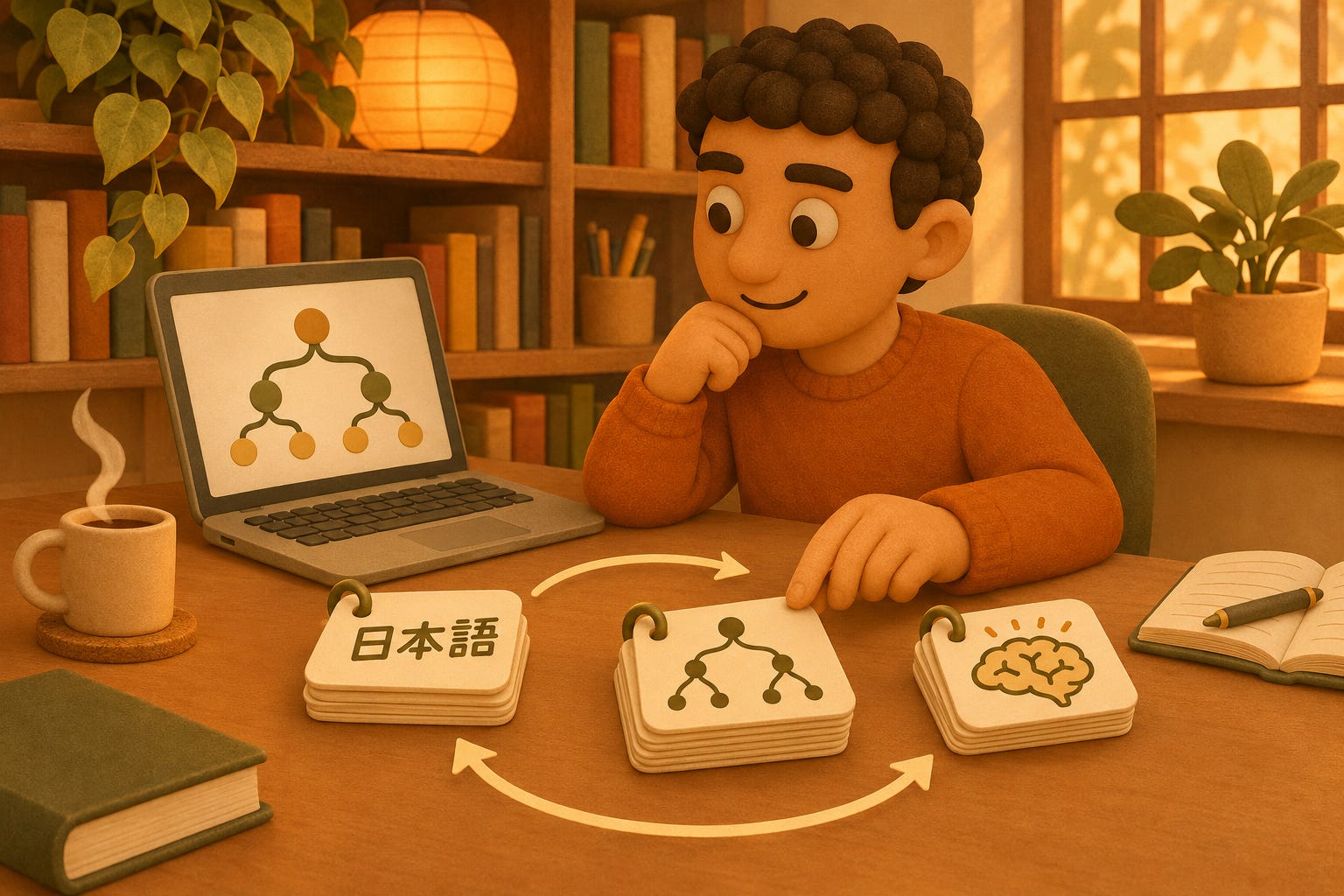
Whatever you’re studying, there are premade decks online with hundreds or thousands of cards. For Japanese, I downloaded the Core 6K deck: the 6,000 most commonly used words. Then I learned 20 to 30 new cards per day, every single day.
Each word you learn comes back for review after an increasingly longer gap, so you never forget it. That’s spaced repetition in practice.
If you’re just starting, begin with 10 new cards per day and increase once it feels comfortable. Budget real time for it. I’ve done over an hour of Anki every day for the last 1.5 years, because new cards are only half the work. The other half is the growing backlog of reviews.
Every single day
The method itself is simple: you do your Anki reviews. The hard part is doing them every single day.
Skip a day and the reviews pile up. The next day you face double the amount, and it snowballs from there. Honestly, I like that. It forces you to keep going.


As you can see, I’ve been extremely consistent, averaging like 350 reviews per day. By now it’s second nature. Doing a lot of active recall every day is simply part of my routine.
Beyond the Core 6K: sentence mining
Once I finished the Core 6K deck, I started making my own cards with a technique called sentence mining.
The idea in one sentence: while immersing myself in Japanese, watching and reading lots of content, I turn sentences with exactly one unknown word into new cards. That’s how I got from 6,000 to over 10,000 words.
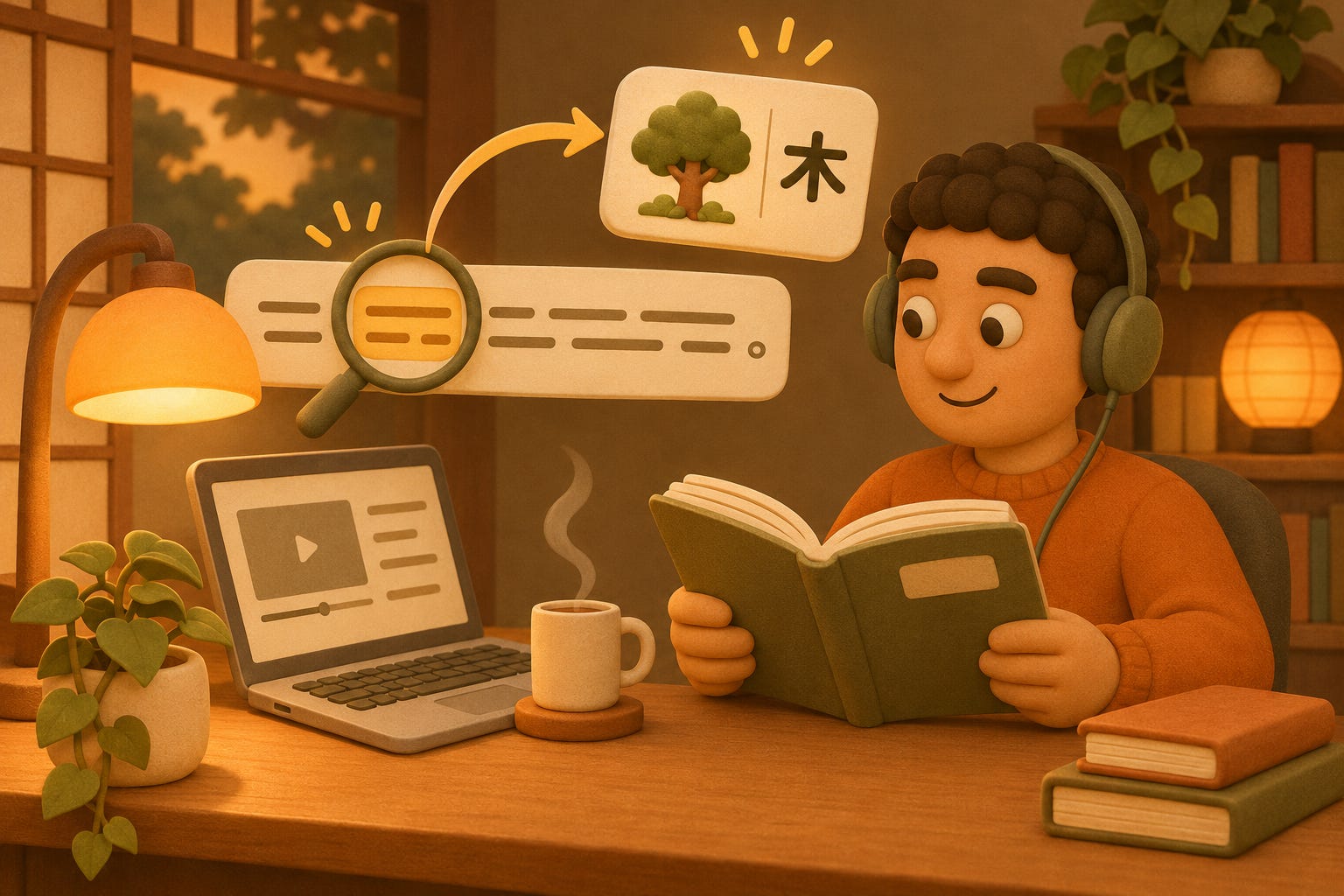
Today, I understand 85 to 95% of the words in an average piece of Japanese content. That makes mining even easier, because many sentences now have just one unknown word. It becomes a self-reinforcing loop: more words, better comprehension, more sentences worth mining.
No special talent required
Learning Japanese has been one of the most rewarding things I’ve done in the last few years, and I wanted to share how I did it.
I’m not particularly smart, and I don’t have superhuman discipline. I found a good method, made it a habit, and stuck with it. Before I knew it, I knew a real chunk of the language.
If you’d like me to go deeper into language learning, let me know.
That’s it for this week.
See you next time
— Tobi
Currently living in Japan as a digital nomad and learning Japanese, would love to read more about your experiences learning the language! Especially forming sentences!