


Bit of an unconventional post today.
I just came back from a trip to Kraków, Poland, where I spent a day at Energylandia, one of the biggest theme parks in Europe, riding some fairly ridiculous roller coasters.
And somewhere between standing underneath these enormous pieces of steel, I realized that roller coasters have actually taught me quite a lot about life.
Which sounds slightly absurd.
But hear me out.
I would consider myself somewhat of a roller coaster enthusiast nowadays. I have ridden dozens of roller coasters and traveled around the world partly to experience some of the craziest coasters that exist (Looking at you, Eejanaika).
But this definitely wasn’t always the case.
I used to be terrified of roller coasters.
Not “a little nervous before the drop” scared. Genuinely scared.
I was scared of heights. I was a pretty anxious kid in general. For heaven’s sake, there was even a point where I was scared of elevators.
The first time I went to a theme park, I chickened out and didn't ride the roller coasters at all.
Then, eventually, I got myself onto my first proper roller coaster.
I don’t remember exactly what changed. I just remember the enormous amount of adrenaline, getting through it, stepping off the ride and realizing:
Wait. That was incredible.
Something about overcoming that fear felt ridiculously rewarding.
And since then, the line of what I consider “too scary” has kept moving further and further away.
That process taught me a few things.
Fear Is Not the Same as Danger
This is probably the biggest one.
When you’re standing underneath a roller coaster and watching people disappear over a 80-meter drop, your body doesn’t particularly care about safety statistics.
It rather sees the height, speed, loud noises and people screaming.
And your nervous system immediately concludes:
We should probably not do this.
Intellectually, you know you’re strapped into an engineered machine designed to carry thousands of people through the same course.
Emotionally, your monkey brain sees impending death.
And I think I would argue that the same mismatch happens constantly in normal life.
Think about some of the things we are afraid of:
Going into a job interview
Asking somebody out
Asking for a raise
Quitting a job
Moving abroad
Taking a monetary risk
Traveling alone
Having a difficult conversation
Performing on stage
Starting something publicly
Looking stupid or embarrassing yourself
I’ve been scared of pretty much everything on that list.
I’ve also done pretty much everything on that list.
None of these things are necessarily dangerous, but they can feel dangerous.
Our brains evolved in an environment where fear was often useful information. If something in the bushes terrified you, there was a decent chance avoiding it increased your odds of staying alive.
The modern world is different.
Today, your nervous system can produce roughly the same alarm response because you’re about to walk onto a stage or send a risky text message.
That distinction has become increasingly useful to me.
Instead of only asking “Does this scare me?”, I’ve started finding this question much more interesting:
“How dangerous is this actually?”
Because those are completely different questions.
Something can score 9/10 on scariness and 2/10 on actual danger. And once you separate the two, a lot of fear starts looking different.
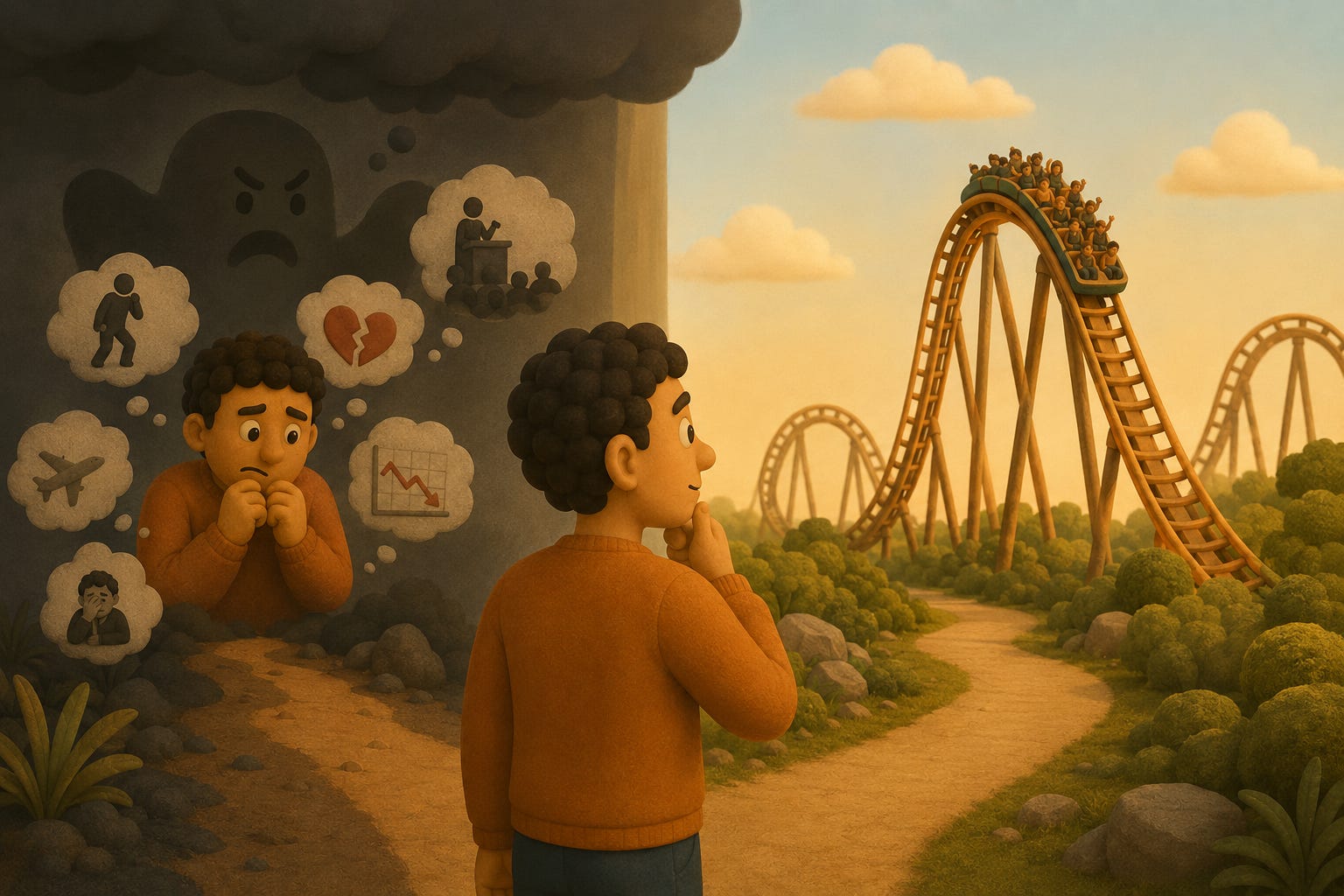
The Anticipation Is Often Worse Than The Thing Itself
Roller coasters make this absurdly obvious.
the minute you see the tall structure in front of you, your mind goes crazy. You think about all the things that could go wrong. You don’t know how your body will feel. You’re thinking, “Is this really safe?” The feeling gets worse while waiting in line or while sitting on the lift hill.
But then you get over the hill.
And within seconds the fear disappears.
You’re no longer imagining the experience, you’re actually experiencing it.
I think there is a broader lesson here because so much suffering happens in anticipation.
A while ago, I wrote about the Buddhist idea of the second arrow.
The basic idea is that pain happens, but then we often create an additional layer of suffering through our reaction to it.
There is something similar happening with fear:
We experience the difficult thing once in reality, but beforehand, we might experience it fifty times in our imagination.
We think about everything that could go wrong.
We simulate the embarrassing conversation.
We imagine ourselves failing.
We picture the worst possible outcome.
Sometimes for days.
Then we finally do it and think:
...that was it?
The imaginary version was worse.
I’ve had this with roller coasters, but I’ve also had it with everyday things in life.
In hindsight, the fear was often wildly disproportionate to the event itself.
Which makes me wonder how many things we avoid not because the experience would actually be terrible, but because the anticipation is.
You Don’t Become Brave and Then Do the Thing
One of the strangest things about my progression with roller coasters is that the scarier rides never became proportionally scarier.
You’d think they would.
If coaster A is twice as tall and much faster than coaster B, surely I should be twice as nervous.
But that’s not really how it worked.
My first roller coaster felt enormous. Then I did something bigger. Then that became normal. Then something bigger again. Then that became normal too.
Something that would have looked completely insane to an earlier version of me eventually became the reference point for the next ride.
My baseline kept resetting.
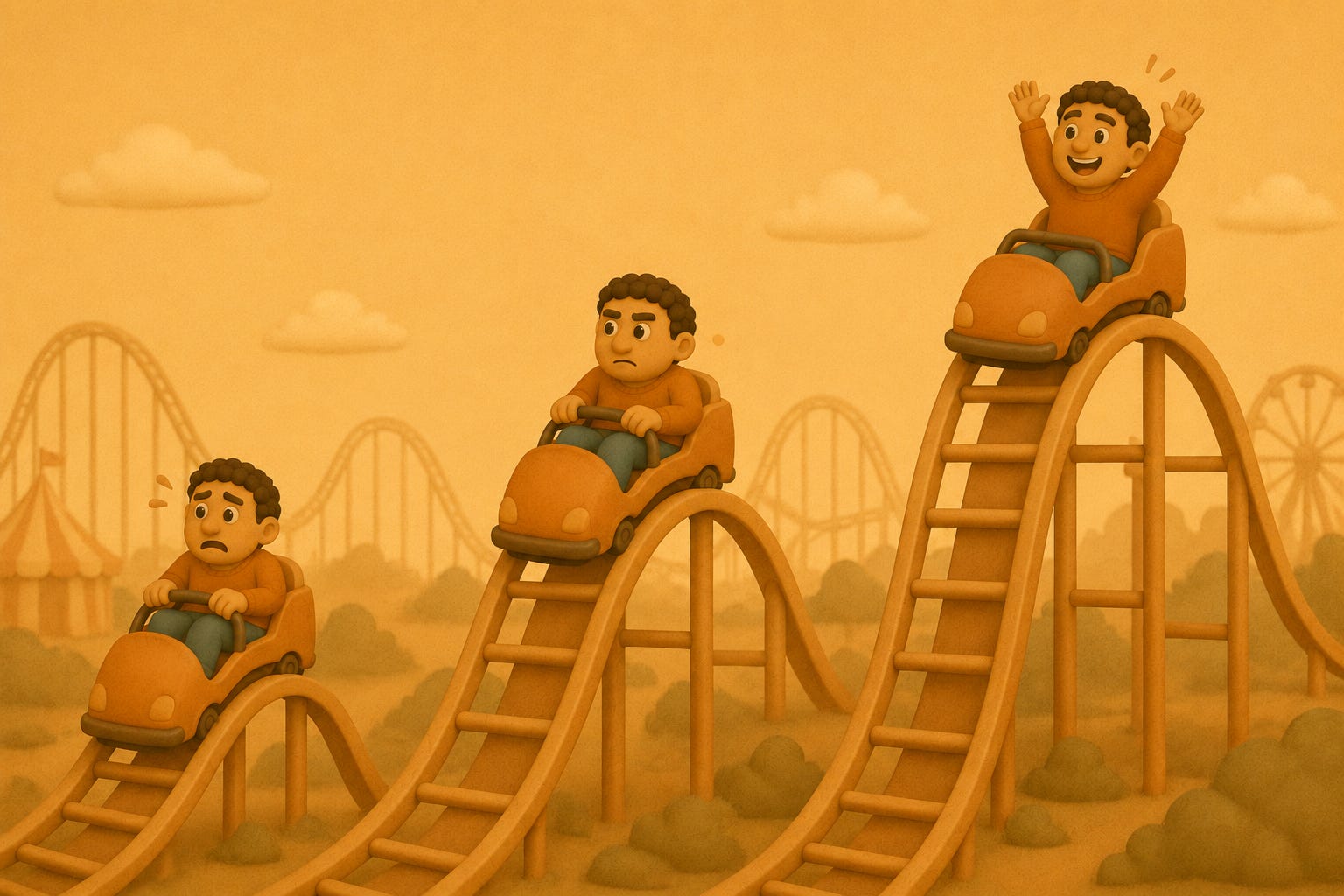
And I think this is almost exactly how comfort zones work.
People sometimes talk about “getting out of your comfort zone” as if you first need to mentally convince yourself to become comfortable with something.
I think it’s usually the opposite.
You don’t become comfortable and then act.
You act, survive the experience, and then become comfortable.
Confidence often arrives after the evidence. Your brain needs proof.
Every time you do something scary and come out fine on the other side, you’re quietly teaching it: “Apparently, we can handle this.”
Do that enough times and the boundary moves.
This is why someone who has given one hundred presentations probably doesn’t need motivational advice about public speaking.
Their nervous system has simply collected one hundred pieces of evidence that standing in front of a room isn’t going to kill them.
The same thing happened to me with roller coasters: I was never perfectly “ready” for the next level. I was ready for the level I had already done. The next one still required a little leap.
And I think that’s how a lot of meaningful progress feels.
You are almost never fully ready for the next level because, by definition, you haven’t been there yet.
Commitment Kills a Surprising Amount of Anxiety
There is another interesting moment that happens before riding an intimidating roller coaster.
You’re standing outside, And technically, you still have options.
You can ride it.
You can leave.
You can wait another ten minutes.
Maybe you’ll do it later.
Maybe tomorrow.
Your brain loves this stage because it can keep negotiating forever.
Then you sit down.
Click.
The restraint locks.
Decision over.
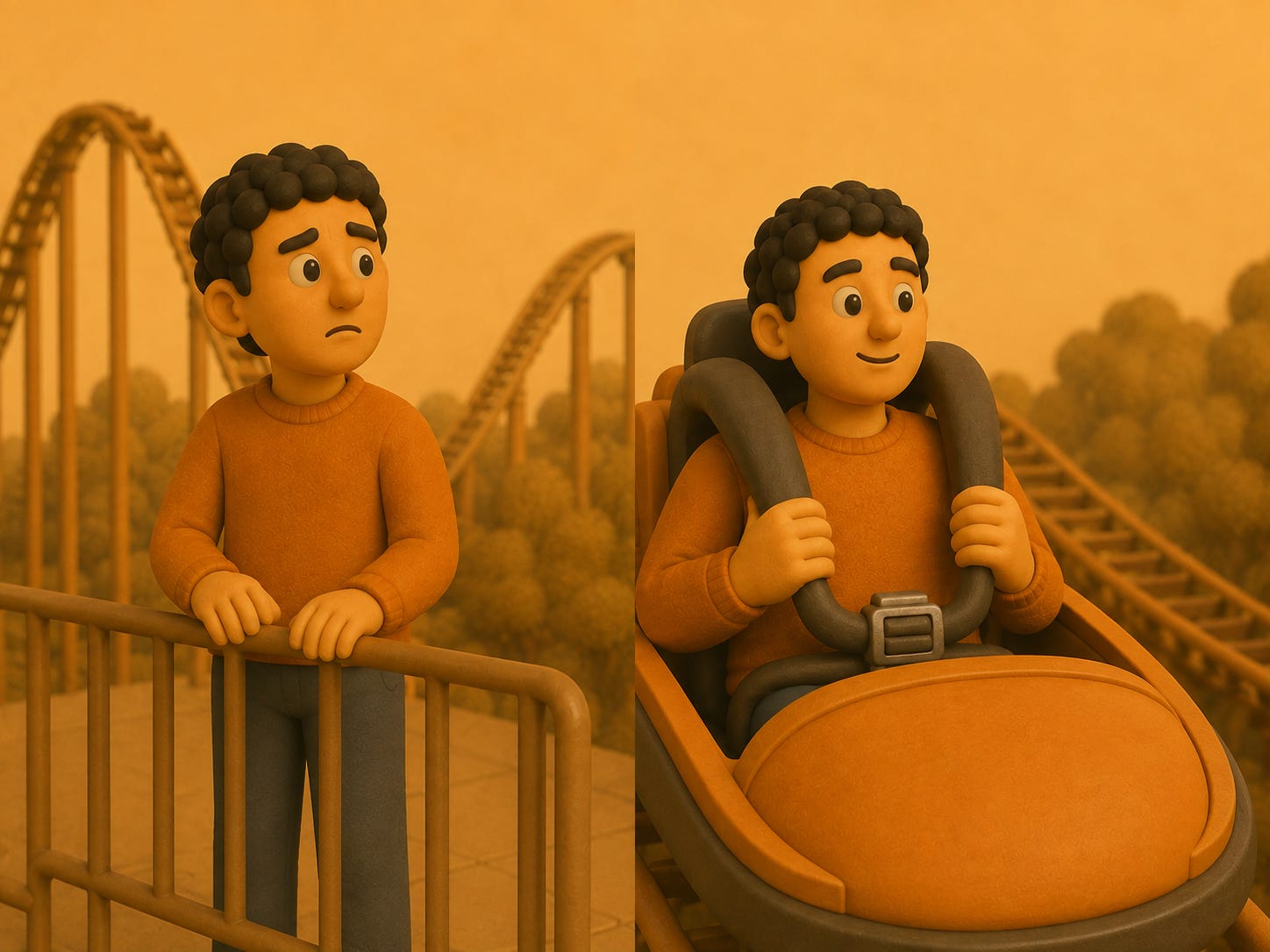
Strangely enough, I often feel calmer at that point.
Nothing about the ride became less scary, but that optionality disappeared.
And I’ve started noticing the same thing elsewhere.
A lot of anxiety seems to live inside questions like:
Should I start?
Should I quit?
Should I ask?
Should I book the flight?
Should I have that conversation?
Should I do it today or tomorrow?
You can spend hours mentally living inside those questions, sometimes even days.
Making the decision doesn’t guarantee that everything will go well, but it removes the exhausting process of continuously deciding.
Once the metaphorical restraint clicks shut, your brain has a different job: Now you just deal with what happens.
There are obviously decisions where keeping your options open is valuable. But I think we massively underestimate how psychologically expensive prolonged optionality can become.
Roller Coasters Force You Into the Present
Try worrying about an email while you’re falling toward the ground at 120 km/h.
Your brain simply refuses.
For those few minutes, there is no:
“What do I need to do tomorrow?”
No work problem.
No awkward conversation replaying in your head.
No worrying about something six months away.
There is just the next turn.
The next drop.
Your stomach somewhere ten meters above your body.
And that’s it.
There is something strangely peaceful about having no mental space left for anything except what is happening right now. In that moment, every little worry in your life is gone for a minute.
The Moments We Nearly Avoid Become the Stories We Keep
This might be my favorite lesson.
Think back to a trip you took five years ago.
What do you remember?
Probably not the hour you spent lying in your hotel room scrolling through your phone.
Probably not some perfectly comfortable breakfast.
You remember the absurd things.
The unexpected night out.
The view after a brutal hike.
The person you randomly met.
The thing everyone was terrified to do.
The story.
There is a strange contradiction here.
In everyday life, we optimize heavily for comfort.
But when we look back at our lives, we often value intensity.
And intensity isn’t always pleasant while it is happening.
Some of my favorite memories involve being scared.
Sitting next to friends on the lift hill of a massive roller coaster while everyone is simultaneously excited and questioning their life choices is an objectively ridiculous situation.
But I know those moments will stick with me.
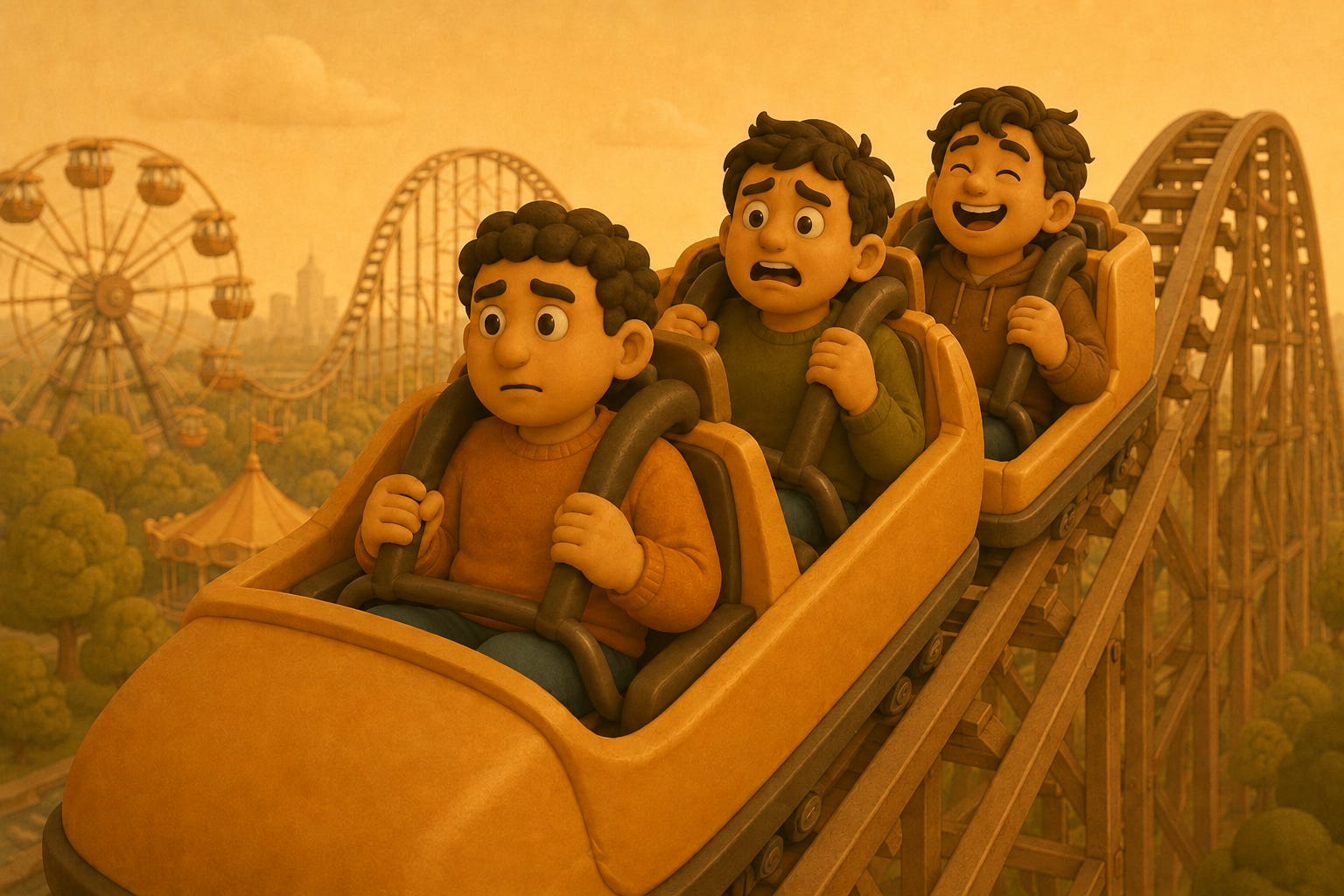
Comfort is pleasant. It just isn’t always memorable.
This connects closely to something I’ve written about before: the difference between the experiencing self and the remembering self.
What feels easiest today isn’t necessarily what you’ll value most five years from now.
And sometimes, the moments we try hardest to avoid beforehand become the stories we enjoy telling afterwards.
Obviously this doesn’t mean discomfort is automatically good.
Misery for the sake of misery is still misery.
But I do think a life engineered to remove every bit of uncertainty, fear, embarrassment and discomfort would probably also remove a surprising number of its best stories.
The Funny Thing About Fear
I still get nervous before certain roller coasters and actually, I like that.
I don’t think the goal should be to eliminate fear entirely.
Part of what makes these experiences exciting is that small voice telling you that maybe this is a terrible idea.
Fear makes your heart beat faster.
It focuses your attention.
It turns an ordinary Tuesday afternoon into a memory you might still talk about ten years later.
The useful question isn’t always how to stop being afraid.
Sometimes it’s simply whether the fear is telling you about real danger, or whether it’s your nervous system reacting to something unfamiliar.
Those are very different situations.
A few years ago, I was the kid who could barely get himself onto a roller coaster.
Now I’ve traveled around the world looking for increasingly ridiculous ones.
I don’t think that happened because I somehow learned how to stop feeling fear.
I think I just got enough repetitions of being afraid, doing the thing anyway, and discovering that the world was still there afterwards.
And looking back, that pattern extends far beyond roller coasters.
Some of the best decisions I’ve made in my life started with a very similar feeling to sitting on a lift hill.
Excitement. Uncertainty. A slightly uncomfortable stomach.
And the thought: Well... we’re already strapped in now.
See you next time.
— Tobi
Question: What have you done lately that you were afraid of?
I agree :) Things aren't as scary as they seem most of the time. If i have nothing to lose, why not shoot my shot?
https://suprajranga.substack.com/p/every-sunday-an-entire-neighborhood?r=5a6cbv&utm_medium=ios