


Here’s a pattern that I see showing up constantly.
Someone decides they want to change. They get motivated. They go hard: 2-hour workouts, 4-hour study sessions, complete diet overhaul, new morning routine.
For about a week.
Then life happens. One day gets skipped. Then another. Then the whole thing collapses. Two months later, they’re back to the starting point.
This isn’t a failure due to willpower. It’s because of strategy.
Intensity without consistency is almost always a dead end.

The math of compounding
1% better every day compounds to 37x better over a year. 1% worse every day compounds to nearly zero.
But here’s what gets missed in the “1% daily improvement” framing: the compounding only works if you actually show up daily.
Five days of 5% improvement followed by a crash doesn’t compound. Steady, consistent, unremarkable effort repeated every single day is what creates the curve.
The power isn’t in the intensity of any single session. The power is in the continuity.
Why intensity feels better than it is
Intensity has a seductive quality that consistency doesn’t. A brutal workout, a 12-hour study session, a full weekend on a project. These feel productive. They feel like they’re moving the needle.
And they do move it. But only if the next session also happens.
What high-intensity efforts often do instead: create soreness and fatigue that forces days of rest afterward, set an unsustainable standard that makes future sessions feel like failure by comparison, drain motivation because the effort was so high that the brain flags it as too costly to repeat.
Intensity is a tool. The problem is when it becomes the strategy.
The consistent 70%
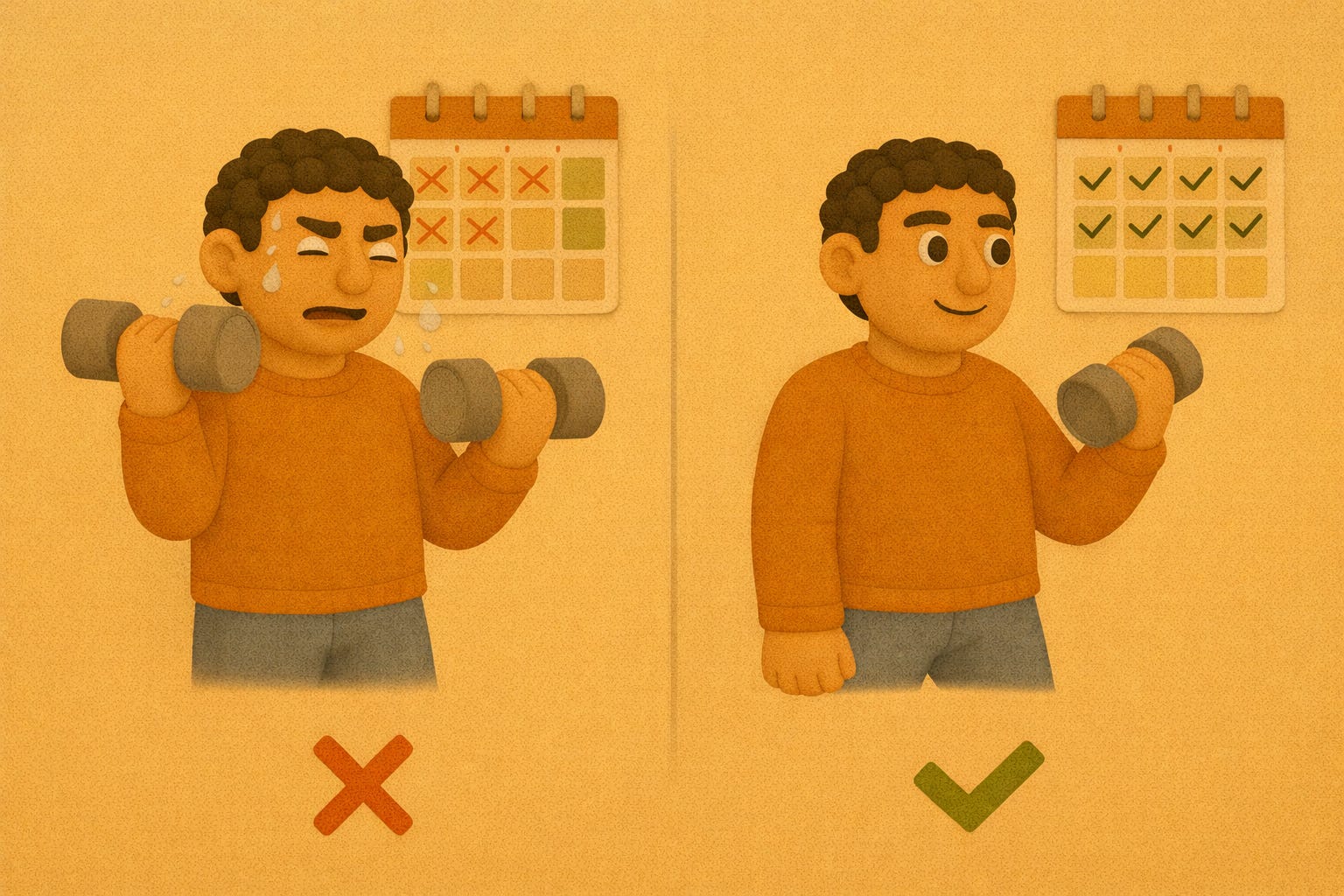
Three 45-minute training sessions every week, without fail, builds more over a year than six 2-hour sessions followed by a two-month gap.
30 minutes of language practice daily moves faster than 4-hour Saturday cramming sessions every few weeks.
The math works out because results aren’t linear with effort. They’re a function of accumulated effort over time. And accumulated effort requires continuity.
The “don’t break the chain” principle
Jerry Seinfeld reportedly used a simple system: mark an X on a calendar for every day he wrote jokes. The goal was just to not break the chain.
The point was not the output on any given day. The streak was.
This is psychologically powerful for a few reasons. It makes the daily action feel non-negotiable: you don’t ask “do I feel like it today?” you ask “how short can I make today’s session and still mark the X?” It creates momentum. A long chain is a visual identity commitment and the longer it gets, the less you want to break it. And it reframes what counts. A 15-minute session on a bad day keeps the chain alive. Without the chain mindset, you’d skip it entirely.
The chain does the work that motivation can’t.
The minimum viable dose
Every habit needs a floor: the version so small there’s no legitimate excuse not to do it.
For fitness: 10 push-ups. For reading: one page. For writing: one paragraph. For language learning: 5 flashcards.
I found that the biggest threat to consistency isn’t busy days. It’s the all-or-nothing mindset.
“If I can’t do the full workout, why bother at all?”
That’s the thinking that is problematic. The “minimum viable dose” kills that logic. You always do something. Even when everything else is falling apart.
Something beats nothing. Always.
And often, starting with the minimum leads to doing more anyway.
The long enough timeframe
Consistency only shows its power over time.
At one month, a consistent habit might not look dramatically different from an inconsistent one. At six months, the gap is noticeable. At two years, it’s compounded into a structural advantage.
Most people give up somewhere in month two, when the effort is real but the results aren’t visible yet. This is the so-called “valley of despair” in every compounding curve.
The people who make it through aren’t necessarily more talented or disciplined. They’re just playing a longer game. They’ve internalized that the visible results come after the invisible investment, not during it.
What this means in practice
Choose consistency over ambition when designing habits.
Not “I’ll train 6 days a week” when you currently go zero times. Start with twice. Add a third when twice is automatic.
Not “I’ll read an hour every night” when you currently don’t read at all. Start with 10 minutes.
Not “I’ll invest €1,000 per month” before you’ve built the saving habit. Start with whatever you won’t notice missing.
Then stay consistent.
Because consistent and small, across years, is how the remarkable things get built.
Thanks for reading!
— Tobi
I think this applies to so so many of us. It's easy to have a lot of intensity for a short period of time, but the long haul seems impossible if you look at it all at once. I often think of the Al Pacino quote from Any Given Sunday - "the inches we need are everywhere". We just have to teach ourselves to recognize the inches as success and not small potatoes.
This hit home. I’ve definitely been the ‘all-in for a week, then disappear for a month’ person more times than I’d like to admit.
What finally clicked for me was exactly what you’re describing—the floor. Once I gave myself permission to do the smallest possible version, I stopped breaking the chain.